 Skip to content


China Best Gas Generator Manufacturer for Global Buyers
Choosing the right China Best Gas Generator Manufacturer for Global Buyers requires more than comparing factory prices. It demands technical judgment, verified production experience, and clear communication from the first inquiry. A reliable Gas Generator supplier should explain engine options, alternator performance, fuel consumption, noise levels, emissions requirements, and expected operating conditions. These details affect every installation, from a backup unit beside a warehouse to a continuous-power system at a remote construction site.
Look closely at manufacturing evidence. Factory photographs are useful, but inspection records, load-test reports, wiring diagrams, and spare-parts plans provide stronger proof. Experienced manufacturers should discuss delivery schedules, container loading, commissioning support, and warranty procedures without avoiding difficult questions. They should also understand regional voltage, frequency, climate, and local compliance requirements. One standard configuration rarely fits every market.
No supplier is perfect.
Even capable factories may have communication gaps, changing component availability, or delays during peak seasons. A careful buyer should recognize these risks instead of trusting impressive promises alone. Ask for references, request a sample quotation, and confirm which parts are original, compatible, or locally sourced. Independent inspection can add confidence before shipment. The best partnership is not based only on low cost. It depends on stable performance, honest documentation, responsive service, and practical engineering support. This guide examines how global buyers can evaluate Chinese manufacturers and select a Gas Generator solution that remains dependable after installation, not merely attractive on paper.
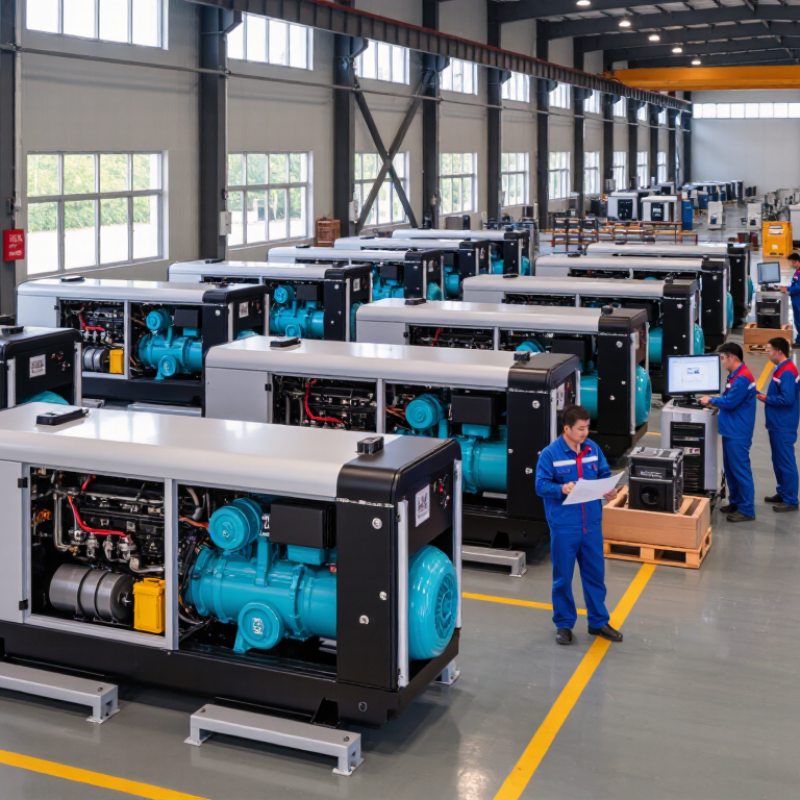
What Defines a Leading Gas Generator Manufacturer in China
China Best Gas Generator Manufacturer for Global Buyers
What Defines a Leading Gas Generator Manufacturer in China
A leading gas generator manufacturer begins with field experience, not attractive brochures. Engineers should understand unstable gas pressure, cold starts, dusty sites, and changing electrical loads. A reliable unit must perform beyond controlled factory conditions.
Look for measurable manufacturing practices. Each engine should receive documented load testing, insulation checks, vibration inspection, and fuel-system verification. Technicians should record serial numbers, component sources, and test results. Clear documentation supports safer installation and easier maintenance. It also reveals whether quality controls are consistent or merely promised.
Technical expertise matters during customization. A serious manufacturer can match generator output with compressors, workshops, farms, or backup systems. It should explain fuel consumption, operating limits, noise levels, ventilation needs, and expected service intervals in plain language. Compliance documents must match the actual configuration, not a similar model. Small details matter.
After-sales support shows operational maturity. Spare parts lists, wiring diagrams, remote troubleshooting, and practical training reduce downtime. Response speed matters when a generator stops during a night shift. No factory gets every decision right. A trustworthy supplier admits design limits and discusses possible failures before shipment. It may recommend a larger radiator, better filtration, or a different control setting. That honesty can cost a sale today, but it protects the buyer’s operation tomorrow.
China Best Gas Generator Manufacturer for Global Buyers - What Defines a Leading Gas Generator Manufacturer in China
| Evaluation Dimension | What Leading Manufacturers Commonly Offer | Relevant Technical Reference | Why It Matters to Global Buyers |
|---|---|---|---|
| Fuel Compatibility | Natural gas, biogas, landfill gas, coal-bed methane, and other approved gaseous fuels, subject to engine configuration and gas quality. | Fuel composition, methane number, pressure, moisture, hydrogen sulfide, and siloxane content must be verified before selection. | Correct fuel matching improves reliability, combustion stability, maintenance intervals, and operating cost control. |
| Power Range | Solutions may cover small standby units below 100 kW, commercial systems from approximately 100 kW to 1 MW, and larger modular power plants above 1 MW. | Final output depends on engine rating, ambient conditions, fuel quality, duty cycle, and site altitude. | A broad product range allows the supplier to match residential, commercial, industrial, agricultural, and utility applications. |
| Operating Mode | Standby, prime, continuous, peak-shaving, microgrid, combined heat and power, and parallel-operation configurations. | ISO 8528 provides internationally recognized classifications and performance concepts for engine-driven generator sets. | Selecting the correct duty rating prevents overheating, premature wear, and inadequate performance under continuous loads. |
| Electrical Output | Common configurations include 50 Hz or 60 Hz systems, three-phase output, and site-specific voltage options such as 380/400 V or 415 V. | Voltage, frequency, phase, power factor, short-circuit performance, and grid-connection requirements must be confirmed in the technical specification. | Electrical compatibility is essential for safe connection to local grids, transfer switches, distribution systems, and sensitive equipment. |
| Fuel Efficiency | Electrical efficiency commonly varies by engine size, load, fuel type, and operating conditions; larger, well-loaded gas engines generally achieve higher efficiency than small units. | Efficiency should be evaluated using documented test conditions, including gas calorific value, load percentage, ambient temperature, and altitude. | Transparent efficiency data provides a more accurate basis for calculating lifetime fuel consumption and operating expenses. |
| Combined Heat and Power | CHP systems can recover engine jacket-water and exhaust heat for hot water, heating, drying, or industrial processes. | Overall CHP utilization can be substantially higher than electrical efficiency alone when recovered heat is used effectively. | Heat recovery can reduce total energy waste and improve project economics where there is a consistent thermal load. |
| Emissions Compliance | Configurations may be designed for applicable local limits on nitrogen oxides, carbon monoxide, unburned hydrocarbons, methane, and formaldehyde. | Requirements vary by country and project; buyers should review local environmental permits and applicable stationary-engine regulations. | Emission compliance affects approval time, after-treatment design, operating restrictions, and total project cost. |
| Safety Engineering | Gas-leak detection, automatic fuel shutoff, emergency stop, ventilation, fire protection interfaces, overspeed protection, and high-temperature alarms. | Safety design should comply with applicable electrical, gas-installation, fire, and workplace-safety regulations at the installation site. | A documented safety system reduces risks to personnel, equipment, buildings, and surrounding communities. |
| Control and Monitoring | Digital controllers with automatic start/stop, load sharing, synchronization, alarms, event logs, remote monitoring, and communication interfaces. | Common communication options include Modbus-based integration and other site-specific supervisory-control interfaces. | Advanced monitoring supports predictive maintenance, faster fault diagnosis, and integration with microgrid or building-management systems. |
| Factory Testing | Documented inspection and testing of rated output, voltage regulation, frequency stability, protection functions, alarms, noise, and load response. | Testing procedures should be defined in the purchase specification and aligned with the applicable generator-set standards. | Factory acceptance testing helps identify assembly or control problems before shipment and commissioning. |
| Certification and Documentation | Quality-management records, technical datasheets, wiring diagrams, installation manuals, operation manuals, spare-parts lists, and conformity documents where required. | ISO 9001 relates to quality-management systems; additional certifications depend on destination market and equipment configuration. | Complete documentation simplifies customs clearance, installation, operator training, maintenance, and regulatory review. |
| Customization Capability | Options may include containerized or open-frame packages, acoustic enclosures, radiator or remote cooling, automatic transfer systems, synchronization panels, and CHP modules. | Customization should be based on site load profile, climate, altitude, noise limits, fuel conditions, and local electrical requirements. | A properly engineered package reduces installation modifications and improves performance in challenging environments. |
| After-Sales Support | Commissioning guidance, operator training, preventive-maintenance schedules, troubleshooting support, warranty procedures, and spare-parts planning. | Service coverage and response time should be clearly stated in the commercial and technical contract. | Reliable support reduces downtime and protects the generator’s availability throughout its service life. |
| Total Cost of Ownership | Evaluation includes purchase price, gas consumption, oil and filter costs, scheduled maintenance, spare parts, installation, emissions equipment, downtime, and disposal. | A lifecycle comparison should use the expected annual operating hours, average load, fuel price, maintenance plan, and project lifetime. | The lowest initial price does not necessarily provide the lowest long-term cost or the highest availability. |
Note: Actual performance, emissions, certification, and fuel compatibility depend on the selected configuration, site conditions, applicable regulations, and verified manufacturer test data.





30 Beach Street, Mt Vernon, NY 10550
914-239-3878 sale@bbqmachine.com
© 2025 by TurboFil Packaging Machines, LLC
© 2025 by TurboFil Packaging Machines, LLC