China Top Warehouse Barcode Labels Manufacturer?
Choosing a China Top Warehouse Barcode Labels Manufacturer requires more than comparing prices. Warehouse Barcode Labels must survive forklifts, dust, temperature changes, and repeated scanning. A label that looks sharp on day one may fade beside a loading dock. That detail matters.
Experienced manufacturers usually discuss the entire application before suggesting materials. They may ask about carton surfaces, pallet movement, printer type, barcode symbology, and storage conditions. Direct thermal labels can suit short-term shipping tasks. Thermal transfer labels often provide stronger durability for long-term identification. Adhesive selection also deserves attention. Rough cardboard, plastic bins, and cold surfaces do not behave alike.
A dependable supplier should provide samples, production specifications, and clear quality controls. Ask how they inspect print contrast, roll winding, die-cut accuracy, and adhesive performance. Practical testing is more convincing than attractive photographs. Scan labels after abrasion, moisture exposure, and repeated handling. Small defects can interrupt inventory records quickly.
China has a broad manufacturing base, but “top” should not mean the loudest marketing claim. It should reflect consistent output, responsive communication, and documented experience. Certifications may support confidence, yet they cannot replace product testing. No manufacturer is perfect. Even a capable factory can miss a requirement when the brief is vague. That is why professional suppliers confirm artwork, core size, roll direction, packaging, and delivery details before production.
This guide examines how to evaluate a China-based manufacturer for reliable Warehouse Barcode Labels. It focuses on material expertise, customization, quality assurance, and practical warehouse performance. The right partner does not merely print labels. It helps prevent scanning errors before they reach the warehouse floor.
Warehouse Barcode Labels: Types, Materials, and GS1 Identification Standards
China Top Warehouse Barcode Labels Manufacturer?
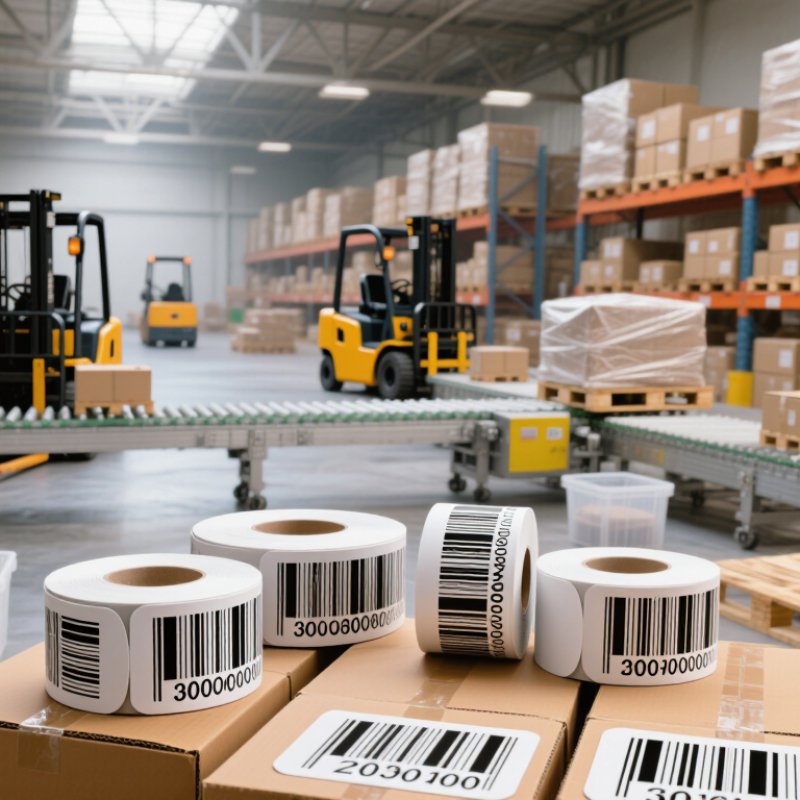
Warehouse barcode labels support receiving, picking, counting, and shipping. Common types include rack labels, pallet labels, carton labels, asset tags, and freezer labels. Direct thermal labels suit short-term cartons and fast-moving shipments. Thermal transfer labels use a ribbon and resist abrasion, moisture, and chemicals better. Paper is economical for dry warehouses. Synthetic materials, such as polyester or polypropylene, perform better on cold, dusty, or outdoor surfaces.
GS1 identification standards connect each label with a defined product or logistics unit. GTIN identifies trade items, while SSCC identifies logistics units, such as pallets. GS1 also recommends structured data through symbols such as GS1-128 and GS1 DataMatrix. GS1 reports that its standards support more than six billion barcode scans daily worldwide. The 2024 MHI Annual Industry Report also found that 55% of supply-chain professionals expect labor shortages to remain a major challenge. Accurate scanning can reduce manual entry, but it cannot repair poor master data. That part is often underestimated.
Tips: Match adhesive strength to the surface and temperature. Test a printed label after rubbing, condensation, and repeated scanning. Keep quiet zones clear around every symbol. Verify GTIN and SSCC data before production. A small gap may cause a large delay. Use independent verification equipment, not only a handheld scanner. Mistakes still happen. Reviewing failed scans each month reveals weak materials, incorrect sizing, or rushed artwork.
GS1 GTIN Identifier Lengths for Warehouse Barcode Labels
A comparison of the fixed digit lengths used by common GS1 Global Trade Item Numbers.
GTIN-8, GTIN-12, GTIN-13, and GTIN-14 are standardized GS1 identifiers containing 8, 12, 13, and 14 digits respectively, including the check digit. The appropriate barcode symbol and label material depend on the item size, scanning distance, surface, and warehouse environment. Common label materials include direct thermal paper, thermal transfer paper, and synthetic films.
How China’s Barcode Label Market Supports 1D and 2D Scanning Requirements
China Top Warehouse Barcode Labels Manufacturer?
China’s barcode label market supports both 1D and 2D scanning requirements across busy warehouses. One-dimensional codes suit cartons, pallets, and shelf locations with simple data needs. Two-dimensional codes store more information in smaller spaces. They can link product details, batch numbers, dates, and traceability records.
Experienced manufacturers adjust label size, adhesive strength, coating, and contrast for each warehouse environment. A cold room needs adhesive that remains stable below changing temperatures. A dusty loading area needs durable printing and clear edges. Reliable suppliers test barcode readability with different scanners, angles, and lighting conditions. They also check print consistency through sampling and production records. Still, no label performs perfectly when surfaces are oily, damaged, or badly positioned.
Tips: Test samples on real cartons, plastic bins, and curved containers. Use both handheld and fixed scanners. Check 1D and 2D readability after rubbing, moisture exposure, and storage. Keep quiet zones clear. A tiny design error can cause delays.
China’s supply network also supports flexible orders, custom dimensions, variable data printing, and material selection. However, the cheapest option may create higher replacement costs later. Buyers should review adhesive performance, core size, roll direction, print resolution, and inspection procedures. Clear technical communication matters. It prevents assumptions that seem harmless during ordering but become expensive on the warehouse floor.
ISO/IEC 15416 Barcode Verification: Grading Accuracy from A to F
A reliable warehouse barcode label begins with verification, not visual appearance. ISO/IEC 15416 evaluates one-dimensional symbols through contrast, modulation, defects, decodability, and quiet zones. Grades usually run from A to F, using a 0.00–4.00 numerical scale. A means 3.50–4.00, while F falls below 0.50. The common scale skips E, which can confuse buyers.
A warehouse label supplier in China should test finished samples with calibrated verification equipment. A scanner may read a damaged code today. That does not prove stable performance tomorrow. Dust, condensation, ribbon wear, and uneven application can reduce the grade. A 2D verification report should record the aperture, wavelength, scan angle, and individual ISO parameters. Small details matter.
The 2024 MHI Annual Industry Report found that 51% of supply-chain leaders expected to adopt robotics within five years. More automation means less tolerance for weak labels. A code graded C may work on a clean bench, yet fail beside a fast conveyor or reflective packaging. My practical view is imperfect: chasing Grade A for every application can increase cost without improving operations. Grade B is often a sensible target, but only after testing the actual scanner, material, distance, and warehouse lighting. A label that survives handling deserves more trust than one that only looks sharp.
China Top Warehouse Barcode Labels Manufacturer? - ISO/IEC 15416 Barcode Verification: Grading Accuracy from A to F
| Grade | Typical Numeric Range | Verification Interpretation | Warehouse Label Condition | Recommended Action |
| A | 3.5–4.0 | Excellent symbol quality with a high margin for reliable decoding. | Strong contrast, accurate bar and space widths, clean quiet zones, and minimal defects. | Suitable for demanding warehouse scanning and automated identification systems. |
| B | 2.5–3.4 | Good quality with dependable decoding under normal operating conditions. | Minor print variation or surface effects may be present but remain within acceptable limits. | Generally suitable for standard warehouse receiving, storage, and picking operations. |
| C | 1.5–2.4 | Acceptable quality, but the symbol has less tolerance for scanning variation. | Reduced contrast, moderate edge roughness, or uneven ink coverage may affect scan reliability. | Use only after confirming performance with the intended scanners, distance, and label surface. |
| D | 0.5–1.4 | Marginal quality with a limited operating tolerance. | Noticeable defects, insufficient quiet zones, low contrast, or dimensional errors may cause read failures. | Investigate print settings, label material, ribbon or ink, barcode dimensions, and application conditions. |
| E | Not assigned | E is not a formal letter band in the commonly used ISO/IEC 15416 A–D and F reporting scale. | A report should use the numeric grade or the applicable letter grade defined by the verification system. | Confirm the grading convention shown on the verifier report before comparing results. |
| F | 0.0–0.4 | Failing or extremely poor quality with a high probability of unsuccessful decoding. | Severe contrast loss, missing bars, excessive defects, incorrect dimensions, or inadequate quiet zones. | Reject or reprint the label and correct the artwork, printing process, substrate, or application method. |
Note: ISO/IEC 15416 quality verification evaluates one-dimensional barcodes using multiple symbol-quality parameters. The displayed overall grade depends on the verifier’s measurement procedure, scan profile, barcode symbology, and the applicable application specification.
Evaluating Chinese Manufacturers by MOQ, ±1 mm Die-Cutting, and Lead Times
Choosing a top Chinese warehouse barcode label manufacturer requires more than comparing quoted prices. In practical sourcing, MOQ often reveals production flexibility. A low MOQ helps test adhesive, liner release, print contrast, and scanner performance. Higher MOQs may reduce unit cost, but they can create slow-moving stock. Ask for a written MOQ by size, material, core diameter, and packaging format. Samples should represent the actual production process, not only a polished laboratory batch.
Die-cutting accuracy deserves equal attention. A stated ±1 mm tolerance can affect label placement on cartons, bins, and curved containers. Request dimensional inspection records from several production lots. Check the label width, corner shape, roll edge, and gap consistency. A simple ruler is useful, but digital calipers provide better evidence. Tolerance claims can vary by material and label size. That detail is easy to miss.
Lead time should include artwork approval, material preparation, printing, die-cutting, inspection, and packing. Many suppliers quote only the factory production period. Ask for separate timelines and a realistic delay allowance. Weather, material shortages, and order peaks can change schedules. Not perfect. A reliable manufacturer explains these risks early and reports changes quickly. Before placing a larger order, run a small trial shipment and measure actual delivery performance. That record is often more valuable than a confident sales promise.
Selecting Suppliers with ISO 9001 Systems, 99.5% Print Quality, and Traceability
Choosing a China warehouse barcode label manufacturer requires more than comparing unit prices. An ISO 9001 system shows controlled procedures, documented training, and corrective-action records. The ISO Survey 2022 reported 1,265,216 valid ISO 9001 certificates worldwide, proving its broad use, but certification alone is not enough. Ask suppliers for recent audit findings and process evidence.
Print quality must be measurable. A 99.5% quality target should include barcode verification, not only visual inspection. Industry guidance commonly treats ANSI/ISO barcode grading as a practical control for readability. Request test reports showing symbol grade, contrast, edge sharpness, and scan performance across warehouse lighting. One failed label can stop a pallet.
Traceability matters more than polished sales language. Each production lot should connect to raw-material records, printer settings, operator checks, and shipment samples. Experienced buyers also request retained samples and a written complaint-response timeline. The Global GS1 System data standards emphasize consistent identification for reliable supply-chain information. This supports scanning at receiving, picking, and dispatch.
Small details reveal maturity. Can the supplier reproduce a label from its batch code? Can it isolate a defective roll within minutes? I have seen suppliers pass visual checks while scanners failed under glare. That gap deserves attention. A supplier may promise 99.5%, yet the calculation method can remain unclear. Ask for the denominator, inspection frequency, and independent verification before approving production.
 Skip to content