Skip to content
What Are the Top 2 Ton FIBC Bags in 2026? This question deserves more than a list of attractive product photos. A reliable 2 Ton FIBC Bags comparison must examine safe working load, safety factors, fabric strength, lifting loops, and filling conditions. It should also consider the material being stored, from dry minerals to agricultural powders.
Packaging engineer Michael R. Dawson offers a practical reminder: “A strong FIBC is only safe when its design matches the load, handling method, and storage environment.” That principle guides this review. The leading bags in 2026 are not necessarily the thickest or cheapest. They are the ones with traceable testing, clear labeling, reinforced seams, and dimensions that suit real warehouse equipment. Forklift access matters. So does stack stability.
Some bags use coated polypropylene for better moisture resistance. Others include polyethylene liners for fine or hygroscopic products. Discharge spouts can reduce dust and product loss, while four-corner loops support smoother lifting. Small design choices matter.
Still, no single bag fits every operation. A bag rated for 2,000 kilograms may require a lower working load in repeated-use conditions. That detail is easy to overlook. It should not be.
This guide compares leading 2 Ton FIBC Bags by construction, usability, certification evidence, and total operating value. The goal is practical selection, not exaggerated marketing. A careful buyer should verify test documents, inspect stitching, and confirm compatibility with the filling and discharge equipment before ordering.
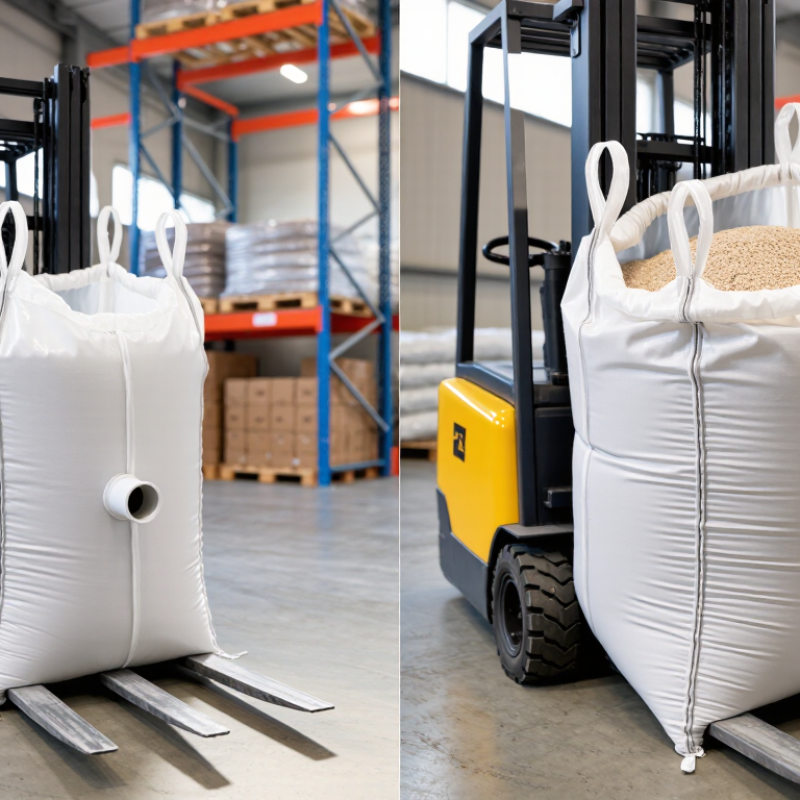
A 2 ton FIBC bag is a flexible intermediate bulk container designed to hold up to 2,000 kilograms of dry, flowable material. It is commonly made from woven polypropylene fabric. Strong lifting loops allow forklifts, cranes, or filling frames to move the container safely. However, “2 ton” does not mean every bag carries 2,000 kilograms in every situation.
The safe working load depends on the bag’s design, fabric strength, lifting method, and safety factor. A reliable specification should state the SWL, test standard, dimensions, filling opening, discharge outlet, and liner requirements. For example, a bag carrying fine powder may need an inner liner to reduce moisture exposure and product leakage. Granular materials may require a different outlet design.
The material matters greatly.
A dense mineral product can stress the seams more than a lightweight agricultural product. Warehouse teams should inspect loops, stitching, fabric, and bottom outlets before each use. Avoid dragging a filled bag across rough concrete. Keep it upright and support it evenly during storage. In practice, capacity labels can mislead when operators ignore product density. I have seen planning focus on weight while overlooking pallet dimensions and unloading space. That mistake is easy to repeat. The top 2 ton FIBC bags in 2026 should be judged by tested load performance, practical handling, and clear documentation, not capacity alone.
A 2 ton FIBC bag is a flexible intermediate bulk container designed to carry a Safe Working Load (SWL) of 2,000 kg. The most suitable construction depends on product flow, filling method, discharge requirements, and handling conditions.
The chart compares common 2 ton FIBC constructions by typical Safety Factor (SF). A 5:1 SF means the bag is designed to withstand five times its rated load under specified test conditions. Actual specifications must be confirmed with the manufacturer and application requirements.
The best 2 ton FIBC bags begin with the right polypropylene fabric. Woven polypropylene offers strong tensile performance and manageable weight. Coated fabric helps resist rain and fine powder leakage. Uncoated fabric allows better breathability for dry, non-sensitive materials. A liner may improve moisture control, but it can complicate filling and discharge.
Design details matter just as much. Four lifting loops support balanced handling with certified equipment. Cross-corner loops can improve stability during lifting. A flat bottom supports stacking on firm warehouse floors. Discharge spouts help reduce dust and material loss. Reinforced stitching is essential around loops, seams, and filling openings. In field inspections, I have seen excellent fabric fail because stitching was rushed. A thicker bag is not automatically safer. The working load, safety factor, filling method, and storage time must match the application.
Tips: Check the safety factor, fabric coating, liner fit, and seam quality before ordering. Request test records and batch traceability. Press the seams by hand. Loose threads deserve attention. Keep bags away from sharp pallets, standing water, and prolonged sunlight. A small design change, such as a wider discharge outlet, can save repeated handling time. Still, every material behaves differently, so trial filling remains worthwhile.
What Are the Top 2 Ton FIBC Bags in 2026?
A reliable 2 ton FIBC bag starts with its Safe Working Load, not its advertised capacity. Check whether the rated load matches repeated lifting or one-time use. A suitable safety factor should support the material, filling method, and storage period. Inspect the fabric for even weaving, firm stitching, and reinforced corners. Loose threads or uneven seams deserve attention. They may reveal poor production control.
Capacity depends on more than volume. A dense mineral product behaves differently from lightweight agricultural material. Measure the bag’s length, width, height, and filling density before selecting it. A liner can improve moisture protection, but it may reduce usable space slightly. Handling features also affect daily efficiency. Four strong lifting loops should remain upright during forklift movement. A wide top opening can speed filling, while a controlled discharge spout helps prevent sudden release. Keep the base stable on pallets.
During warehouse checks, I would test a filled bag at low lifting height first. Watch for loop distortion, fabric stretching, and shifting contents. Do not rely only on supplier photographs or a printed specification. Request test records, inspection details, and clear handling instructions. Some bags look robust but have weak discharge stitching. That is easy to miss. No checklist is perfect. Recheck the bag after storage, especially where sunlight, moisture, or rough pallet edges are present.
For 2026, the best 2 ton FIBC bag options depend on material, filling method, and handling conditions. A standard four-panel bag suits sand, minerals, grains, and many dry powders. Its flat panels support efficient stacking and warehouse storage. U-panel designs offer similar strength with fewer stitched seams. That can reduce weak points during repeated handling.
A coated 2 ton FIBC bag helps protect moisture-sensitive contents during transport. An uncoated bag allows better airflow for dry, stable materials. Bags with polyethylene liners provide an extra barrier against dust and humidity. For fine powders, a sift-proof construction prevents leakage through the stitching. Discharge spouts can make emptying cleaner and faster. They also reduce product loss around the work area.
Conductive or static-dissipating options may suit controlled industrial environments, but selection requires a qualified safety review. The bag’s safe working load must be clearly marked, and the safety factor should match the handling plan. Lifting loops need compatible hooks and balanced loading. Never judge quality by fabric thickness alone. Seam design, testing records, and storage history matter too. I have seen a strong-looking bag perform poorly after long outdoor exposure. That detail is easy to miss. Buyers should request test documentation, inspect every bag before use, and confirm whether the design fits forklifts, cranes, automatic filling lines, or manual discharge.
Choosing the right 2 ton FIBC bag starts with the material, not the advertised capacity. A woven polypropylene bag may suit sand, grain, minerals, or plastic pellets. For dusty powders, choose a coated body or a fitted polyethylene liner. Moisture-sensitive materials need stronger protection. A clean, food-grade construction may be necessary for agricultural products.
Check the bag’s safety factor and working load rating. A 2 ton bag should be tested for repeated lifting, stacking, and transport conditions. Four sturdy lifting loops are practical for forklift handling. Corner seams should look even, tight, and free from loose threads. Dimensions also matter. A tall bag can become unstable when filled, while a wider design may occupy more warehouse space. Measure your pallets and storage racks before ordering.
Discharge style affects daily work. A bottom spout supports controlled emptying, while a full-open bottom saves time during rapid unloading. Add a top inlet that matches your filling equipment. I have seen operators ignore this detail and create unnecessary dust and delays. Ask for batch records, load-test results, and material specifications. A clear document trail improves reliability. Still, no bag is perfect for every application. Real performance can change with humidity, rough handling, and poor stacking. Trial one filled bag under actual site conditions before purchasing a large quantity.
Application-based comparison of commonly specified 2,000 kg flexible intermediate bulk container configurations.
| Rank | Recommended Configuration | Typical Dimensions (L × W × H) | Safe Working Load | Safety Factor | Top / Bottom Design | Liner & Fabric Guidance | Best Application |
|---|---|---|---|---|---|---|---|
| 1 | Standard U-Panel FIBC Cost-efficient general-purpose option | Approx. 90 × 90 × 120 cm | 2,000 kg | Commonly 5:1 Reusable only when specified | Open top or duffle top; flat or standard discharge bottom | Polypropylene fabric typically 160–220 g/m²; optional polyethylene liner for moisture or fine powders | Minerals, grains, fertilizers, pellets, and non-hazardous dry bulk materials |
| 2 | Baffle FIBC Space-saving shape retention | Approx. 90 × 90 × 120 cm | 2,000 kg | Commonly 5:1 | Filling spout or duffle top; discharge spout or flat bottom | Baffle panels improve cube utilization; liner can be attached or free-standing | Warehousing, palletized transport, container loading, and products requiring stable stacking |
| 3 | Four-Panel FIBC Rigid rectangular form | Approx. 95 × 95 × 120 cm | 2,000 kg | Commonly 5:1 or 6:1 | Open, filling spout, or duffle top; flat, petal, or discharge bottom | Woven polypropylene construction; liner recommended for hygroscopic or dusty products | Dense powders, food ingredients, chemicals, and applications needing consistent pallet dimensions |
| 4 | UN-Tested FIBC For regulated dangerous goods, when certified | Approx. 90–95 × 90–95 × 120 cm | Up to 2,000 kg, subject to certification | 5:1 or 6:1, as marked and tested | Configuration depends on the UN design approval | Must use the tested construction, closure system, liner, and labeling specified in the UN certificate | Certain solid dangerous goods transported under applicable UN packaging requirements |
| 5 | Type C Conductive FIBC Groundable antistatic construction | Approx. 90–95 × 90–95 × 120 cm | 2,000 kg | Commonly 5:1 or 6:1 | Filling and discharge options selected by process requirements | Conductive yarns or grid must be electrically connected to ground before filling, discharging, or handling | Combustible powders or flammable atmospheres where a verified grounding procedure is available |
| 6 | Type D Dissipative FIBC Static-control option without routine grounding | Approx. 90–95 × 90–95 × 120 cm | 2,000 kg | Commonly 5:1 or 6:1 | Usually selected with process-specific filling and discharge spouts | Special dissipative fabric; performance depends on the approved design and operating environment | Hazardous dust-handling areas where grounding a Type C bag is impractical; requires competent risk assessment |
| 7 | Food-Grade FIBC with Liner Hygienic product-contact configuration | Approx. 90–95 × 90–95 × 120 cm | 2,000 kg | Commonly 5:1 | Filling spout, duffle top, and hygienic discharge spout | Clean woven polypropylene with a food-contact polyethylene liner where required; liner thickness often 50–100 microns | Flour, sugar, starch, powders, seeds, and other controlled-hygiene ingredients |
| 8 | Moisture-Resistant FIBC Protection against humidity and contamination | Approx. 90–95 × 90–95 × 120 cm | 2,000 kg | Commonly 5:1 | Filling spout or duffle top; discharge spout or flat bottom | Coated polypropylene or polyethylene liner; select UV stabilization for outdoor exposure | Hygroscopic powders, agricultural products, minerals, and storage or transport in humid conditions |


30 Beach Street, Mt Vernon, NY 10550
914-239-3878 sale@bbqmachine.com
© 2025 by TurboFil Packaging Machines, LLC